
Convergence of health and climate: shaping India’s NDCs and pathway towards COP31
Oneworld Colab (OwC) x SHE Changes Climate
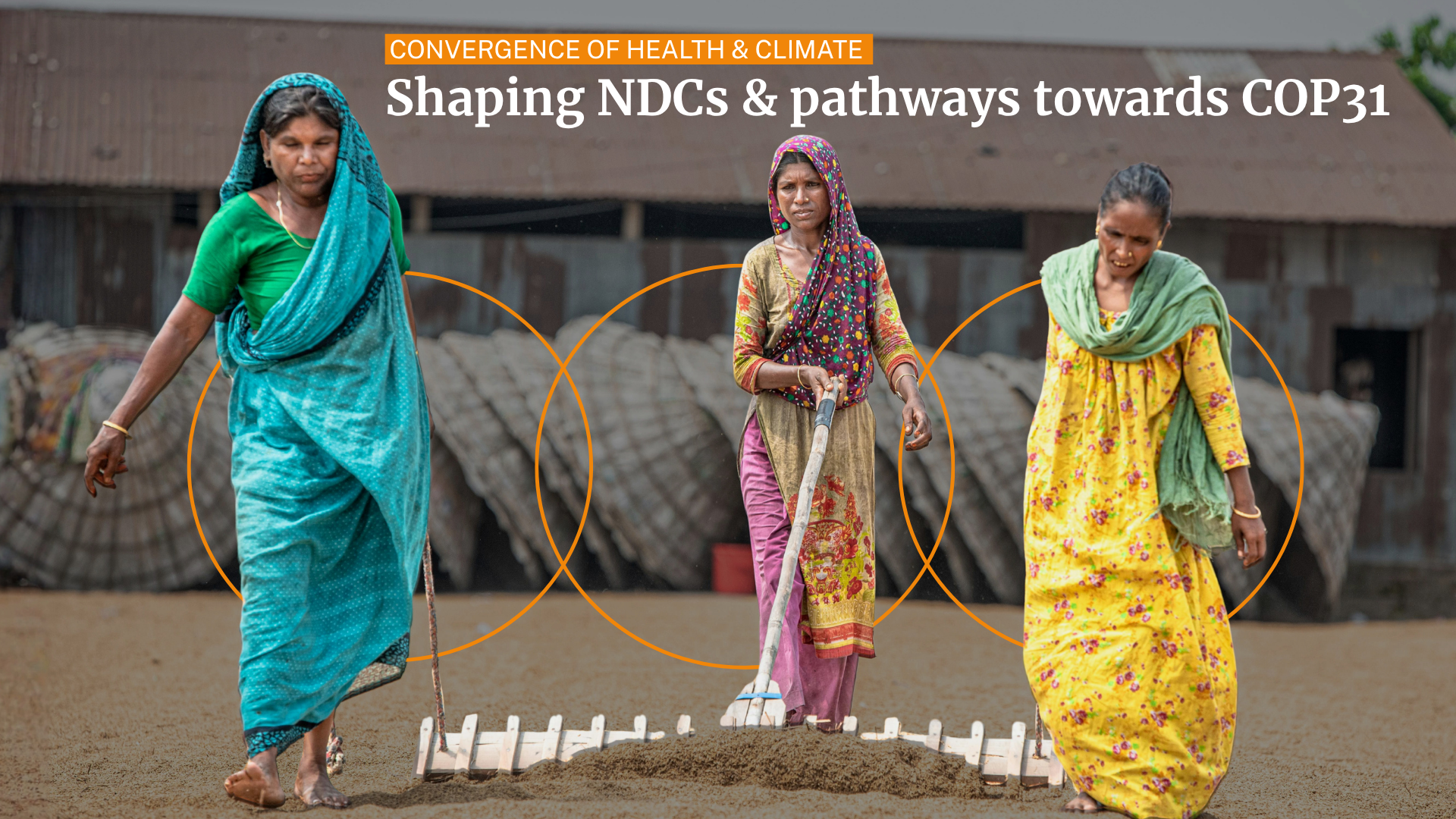
On 27 March 2026, twelve senior experts gathered in a closed-door roundtable convened by Oneworld Colab (OwC) and SHE Changes Climate. They represented the public health, climate research, gender equity, grassroots delivery, data science, and philanthropy sectors to arrive at the same conclusion from different directions.
The separation of health and climate policy in India is producing measurable, preventable harm, and it is borne almost entirely by women.
This blog distils what was found through the roundtable, and what it means for funders who care about impact.
India's climate story is remarkable, and incomplete
India achieved 50% non-fossil installed electricity capacity in 2025, five years before its own 2030 target. NDC 3.0, approved by the Cabinet in March 2026, commits to a 47% reduction in emissions intensity, 60% non-fossil power, and expanded carbon sinks. These are genuine achievements on mitigation. However, mitigation is only half the picture. The NDC's adaptation provisions: heat action plans, disaster early warning, climate-resilient agriculture, contain a striking omission: not a single mention of the Ministry of Health and Family Welfare or the Ministry of Women and Child Development as implementing stakeholders. NDC 3.0 mentions that climate commitments are "likely to generate new opportunities for youth and women." Roundtable participants described this as wholly inadequate given the scale and immediacy of documented health impacts on women and marginalised communities.
What is climate change actually doing to women's health?
The roundtable brought together field evidence that, taken together, paints a picture of compounding, invisible harm.
Maternal Health
Research by Population Council Consulting and Y-Labs has linked prenatal heat exposure to preterm birth, stillbirth, low birth weight, and gestational complications. A structural pattern amplifies the risk: most rural pregnancies are conceived in winter, placing critical second and third trimesters squarely in peak summer heat. At the same time, extreme heat reduces both health-seeking behaviour by pregnant women and outreach capacity of ASHA workers; a simultaneous collapse of supply and demand in maternal care.
Reproductive and Mental Health
Beyond preterm birth: PTSD and mental health impacts following displacement, trafficking surges after floods and cyclones, rising pre-eclampsia and gestational diabetes, adolescent girls pulled from school as care burdens increase. The full reproductive health cycle is implicated.
Climate-linked mental distress is doubly invisible: cultural taboos suppress reporting, and clinical frameworks lack tools to attribute anxiety and grief to climate drivers. The broken attribution chain means no data, no policy, no funding.
Invisible daily exposure
Women's daily routines: collecting water, cooking with biomass, providing care, constitute chronic, cumulative heat and air pollution exposure that never appears in impact assessments. Field research in Bihar found women informal workers labouring 12–14 hour shifts without shade, toilets, or drinking water. The majority belong to SC/ST communities, meaning climate health burden stacks directly onto existing structural inequality.
Where the policy architecture breaks down
The roundtable identified four structural failures: not gaps in knowledge, but gaps in institutional design.
No Climate and Health Act: Heat action plans are advisory only. States may implement them or not. There is no regulatory mandate, no enforceable coordination between National Centre for Disease Control (NCDC) and National Disaster Management Authority (NDMA), and no accountability trail to NDC commitments
No National Adaptation Plan: India's National Adaption Plan (NAP) was expected around COP30 and remains unfinished. Without it, NDC commitments are "destined intent" with no binding state-level translation mechanism
No sex-disaggregated climate-health data: Heat action plans contain no pregnancy-status data. Health Management Information System (HMIS) and Integrated Disease Surveillance Programme (IDSP) are not linked to climate hazard maps. In the Indo-Gangetic Plain, attempts to find equity-disaggregated air quality health data returned nothing at all
No gender-tagged health adaptation finance: India's 2025 climate finance taxonomy draft lacked gender-responsive health linkages entirely, failing to distinguish disaster, adaptation, and green finance; creating accountability vacuums
What needs to change and where funders fit
The roundtable produced eleven concrete recommendations across four domains. Below are those most directly relevant to philanthropic strategy.
1. Pass a Climate and Health Act: Transform advisory heat action frameworks into regulatory mandates. Funders can support the legal and policy development work required to draft and advocate for this legislation
2. Commission a National Climate-health Equity Dashboard: A sex- and age-integrated dashboard linking HMIS, IDSP, and climate hazard mapping. Philanthropies are well-positioned to fund the data infrastructure and pilot design that makes this dashboard politically viable
3. Create gender-tagged health adaptation budget: National and state climate finance must include a dedicated, gender-tagged allocation for health adaptation. Funders should update their own climate-health financing taxonomies as a first step
4. Use SHGs as primary community consultation channels: SHG-mediated consultations in Jharkhand produced richer, more actionable feedback than gram panchayat processes. Programme design funding routed through SHGs yields higher women's participation
5. Shift from activity tracking to outcome measurement: Monitoring must move from expenditure tracking to outcome indicators. Funders should require this of grantees, and model it in their own reporting
The ask for philanthropies
A senior philanthropic expert at the roundtable put it honestly: "Philanthropies, including our own, are still in a learning and curiosity mode. We have strong high-level commitments on climate-health intersections. But what we actually support at the implementation level still feels hazy. That gap needs to be closed urgently."
This is not a critique, but it is an accurate description of where the sector stands. The intellectual case for integrating health and climate is made. The political window: COP31, a freshly submitted NDC 3.0, a pending National Adaptation Plan, is open. What remains is the translation from commitment to implementation.
Funders can accelerate that translation by:
Funding the data infrastructure (the equity dashboard) that makes gendered health impacts legible to policymakers
Supporting the legal and institutional advocacy needed for a Climate and Health Act
Updating climate-health financing taxonomies to include gender-responsive health linkages
Resourcing state-level advocacy alongside national-level policy work
Requiring outcome-based, equity-disaggregated reporting from the climate-health grantee
The roundtable on 27 March made one thing clear: the science is settled, the political window is open, and the communities bearing the cost cannot wait. India’s climate ambition, however commendable on mitigation, will remain structurally incomplete as long as the women most exposed to its consequences remain unheard in adaptation plans, health data systems, and finance flows. COP31 presents a concrete deadline. NDC 3.0 presents a live document that can still be strengthened through implementation. For philanthropies, the ask is not to reinvent strategy but to close the distance between stated commitment and funded action by investing in the data, law, and community infrastructure that turns intent into accountability. The convergence of health and climate is no longer a hypothesis. It is a policy design problem with known solutions. What it needs now is the sustained, gendered, equity-centred funding to make those solutions real.